
Product details
Product number
911-S7-09-00001
Type of source
CF40
Flange
CF40
Ion current
< 1 nA
Final energy
< 10 keV × q
Energy feed
Electron gun
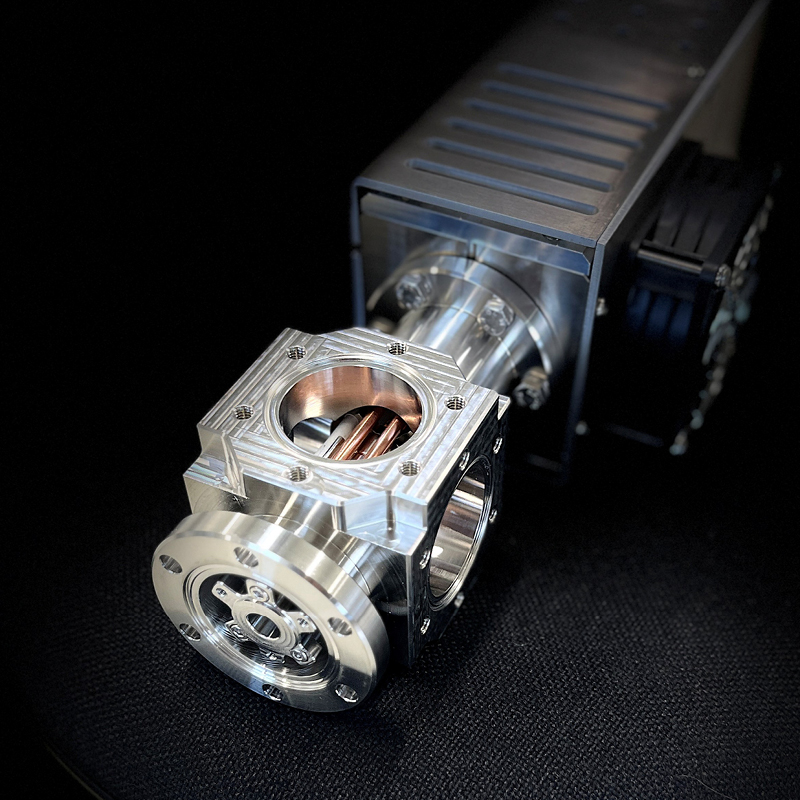
The D.I.S EBIS-C1 is an electron beam ion source featuring an ultra-compact design while still being capable of producing beam currents of several hundred picoamperes (pA) of multi-charged ions of all gaseous elements and compounds. Themodular and operator-friendly D.I.S EBIS-C1 is suitable for use in a wide variety of applications for basic research in various scientific disciplines, for teaching and training, and for technological applications.
Documents
Special features
- Ultra-compact, modularized electron beam ion source (EBIS) mounted on a DN40CF flange for easy integration into customized facilities
- Beam currents of several hundred picoamperes (pA) of multi-charged ions from all gaseous elements and compounds
- Ion generation for ion extraction and X-ray/UV/EUV spectroscopy
- Two cathode options with different diameters available depending on the field of application
- Wien filter module for ion charge state and mass selection
- Easily combinable with other charged particle beam-related devices
- Simple, cost-effective, and user-friendly access to the world of highly charged ions
Frequently asked questions about ion source EBIS
FAQ´s operations
-
What energy can the produced ion beam reach?
The drift tubes of the D.I.S electron beam ion source EBIS-C1 can be ramped up to a voltage U of 10 kV and the whole range can be used for generating ions, starting at 10 V. The resulting kinetic energy of the extracted ions depends on that voltage and the charge state q of the ions, calculated via U×q. The energy of singly-charged ions can reach up to 10 keV while when considering for example a Xe30+ ion a kinetic energy of up to 300 keV is possible.
-
What particles can be ionized with the D.I.S EBIS-C1?
The electron beam ion source EBIS-C1 can ionize any atom or molecule introduced to the vacuum in a gaseous phase. The use of bottles gas in connection with a gas dosing valve is the easiest method but the introduction of materials which are solid at standard condition is possible via sputtering, high-temperature ovens and the MIVOC method. Please contact D.I.S Germany for any questions regarding your specific experiment and the desired ions. See also our tutorial on the introduction of metal compounds into ion sources in the “Expertise” section.
-
What is an electron beam ion source used for?
Electron beam ion sources have a wide range of use in different research fields. The extracted ion beam can be used for implantation and surface modification experiments. Some applications do not require the extraction of ions, such as fundamental research into (highly charged) ions using spectroscopic methods such as x-ray spectroscopy.
FAQ´s requirements
-
What additional devices are needed to operate the D.I.S EBIS-C1?
The D.I.S electron beam ion source EBIS-C1 can be delivered with all power supplies necessary for the operation. Please contact D.I.S Germany for a list of the requirements regarding the power supplies in case you want to use your own. In addition to these devices, the use of a pressure gauge in close vicinity to the ion beam source is advised to ensure stable working conditions and the durability of all components. A wide range of techniques for introducing the desired compounds to be ionized is also available and required depending on your specific use case.
-
What are the vacuum demands for the D.I.S EBIS-C1?
The D.I.S electron beam ion source EBIS-C1 can operate at a pressure of up to 1×10⁻⁷ mbar with the partial pressure of the desired particles being in the range of 5×10⁻⁹ mbar to 5×10⁻⁸ mbar for most optimized operating conditions. To allow for that partial pressure while remaining below the maximum pressure and reducing the disruptive effect of residual gas, a base pressure below 5×10⁻⁹ mbar is advised.
FAQ´s physics
-
What electron energy and electron beam current is available for ionization?
The electron energy can be varied between 50 eV and 13 keV. The electron beam current is variable up to 10 mA and depends on the applied voltages. The electron beam current is limited for lower voltages. Please consult D.I.S Germany for use cases such as low-energy experiments.
-
What process does an EBIS use for ionization?
Electron beam ion sources rely on electron impact ionization by using a compressed high-current electron beam to generate a plethora of charge states. Other processes such as double electron impact ionization, the Auger process, or autoionization processes are supporting especially charge breeding for higher charge states, while antagonistic processes like charge exchange with neutrals, especially with residual gas, are kept in check by choosing the right operating parameters.